Why Smoke Odor Is So Hard to Eliminate
If you’ve ever walked into a home and instantly smelled smoke—even when no one’s smoking—you already know the truth:
Smoke doesn’t just linger. It embeds.
In Maine homes, especially those with closed windows during long winters, smoke odor becomes even more persistent. Whether it’s cigarette smoke, fireplace residue, or fire damage, that smell gets trapped in walls, fabrics, HVAC systems, and even microscopic surfaces.
Here’s the reality most people miss:
If you can smell smoke, the source is still active.
That means surface cleaning alone won’t solve the problem.
What Makes Smoke Odor So Persistent?
Smoke is made up of ultra-fine particles and gases that behave differently than typical dirt or dust.
What actually happens:
- Particles penetrate porous materials (drywall, wood, fabric)
- Residue bonds to surfaces at a molecular level
- Odor compounds slowly re-release into the air over time
This is why:
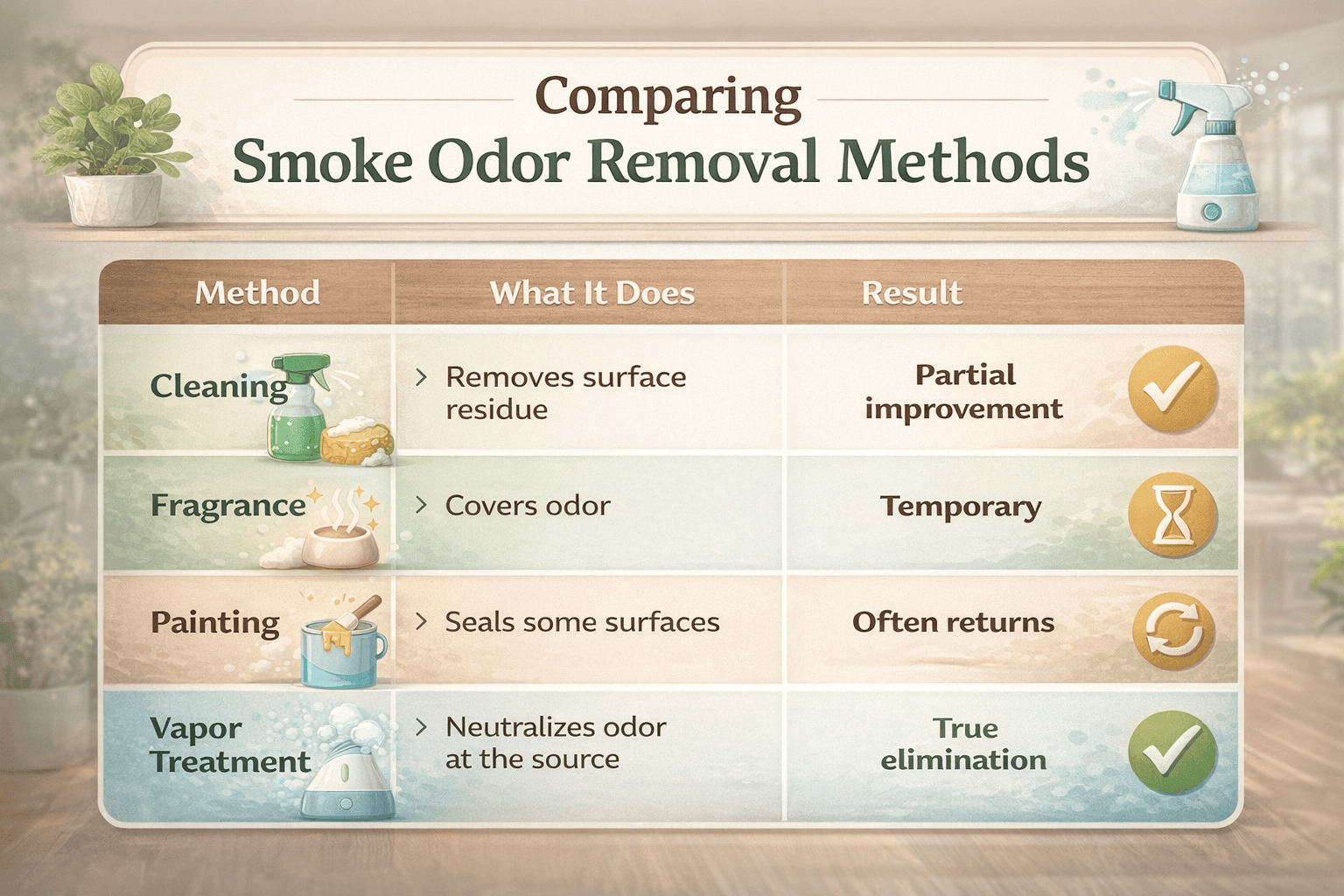
- Painting over walls doesn’t fix it
- Air fresheners only mask it
- Basic cleaning barely scratches the surface
Smoke odor is not a surface problem—it’s a contamination problem.
Why This Matters Now (Especially in Maine)
Indoor air quality is becoming a bigger concern, especially in regions like Maine where homes are sealed tight for months.
Key factors:
- Long winters = less ventilation
- Increased awareness of indoor air quality
- Higher expectations for rental and resale properties
- Stronger buyer sensitivity to odor during home inspections
A lingering smoke odor today doesn’t just affect comfort—it can:
- Reduce property value
- Delay home sales
- Lead to tenant complaints
- Damage first impressions instantly
Common Misconceptions About Smoke Odor Removal

❌ “If I clean everything, the smell will go away”
Cleaning removes surface residue—not embedded odor molecules.
❌ “Air fresheners or candles fix the issue”
They only cover the smell temporarily. The source remains.
❌ “Ozone or bleach solves everything”
These can help in controlled situations, but alone they rarely eliminate deep contamination—and misuse can create safety concerns.
❌ “Painting over it seals it”
Odor often comes back because it’s still active behind the surface.
Masking is not removal. Neutralizing at the source is the only real solution.
A Real Maine Scenario
A homeowner in Bangor buys a house that “smelled fine” during a quick showing.
Two days after moving in… the smell hits.
- Smoke odor intensifies in warmer temperatures
- Upholstery and carpets release trapped odor
- HVAC system spreads contamination throughout the home
They try:
- Deep cleaning
- Repainting
- Air purifiers
The result? Slight improvement—but the smell keeps returning.
Why? Because the odor source was never fully eliminated.
What Actually Works: True Smoke Odor Elimination

Step 1: Source Identification
You have to locate where the odor is embedded:
- Walls and ceilings
- Flooring and subfloor
- Furniture and fabrics
- HVAC systems
Step 2: Deep Pre-Cleaning
Removing physical residue is critical before treatment:
- Soot removal
- Surface cleaning
- Fabric extraction
Step 3: Vapor-Based Odor Neutralization
This is where real results happen.
Professional systems use vapor-phase treatments that:
- Penetrate porous materials
- Reach inside walls, fabrics, and hidden spaces
- Break down odor molecules at the source
Unlike sprays or fogs that sit in the air, vapor moves through the same pathways smoke used to contaminate the space.
Step 4: Air Treatment & Filtration
To complete the process:
- Airborne particles are removed
- Remaining contaminants are neutralized
- Indoor air quality is restored
Why Professional Odor Removal Matters
DIY approaches usually fail for one simple reason:
They don’t reach deep enough.
Professional odor removal in Maine focuses on:
- Source-level penetration
- Whole-space treatment (not just surfaces)
- Safe, controlled processes
- Proven odor neutralization—not masking
If the treatment doesn’t reach where the smoke went, the odor will come back.
Deep Cleaning vs. True Odor Removal
Let’s draw a clear line:
The Outcome: What Complete Smoke Odor Removal Looks Like
When done properly, you get:
- No lingering smell—even in humidity or heat
- Improved indoor air quality perception
- Restored comfort in the space
- Better property value and marketability
- Confidence for buyers, tenants, and guests
The goal isn’t to “smell better.” It’s to eliminate the odor entirely.
Future Insight: Where Odor Removal Is Headed
We’re seeing a clear shift:
- Increased demand for non-toxic, effective odor solutions
- More scrutiny in real estate transactions
- Greater awareness of airborne contaminants
- Movement away from ozone-heavy or chemical masking methods
The future is about precision odor elimination—not guesswork.
Conclusion: Can Smoke Odor Be Completely Removed?
Yes—but only if you treat the problem correctly.
Smoke odor removal in Maine is absolutely possible, but it requires:
- Understanding how odor behaves
- Targeting the source—not just the symptoms
- Using professional-grade methods designed for deep penetration
If you can smell it, it’s still there—and it needs to be eliminated at the source.
Call to Action
If smoke odor is affecting your home, property, or vehicle, don’t waste time on temporary fixes.
Get it handled the right way—completely.
FAQs
1. Can smoke odor ever be completely removed?
Yes, but only with source-level treatment that penetrates materials where odor is embedded.
2. Why does smoke smell come back after cleaning?
Because odor particles remain inside porous materials and continue to release over time.
3. Does repainting remove smoke odor?
No, it may temporarily hide it, but the odor often returns.
4. Is ozone the best solution for smoke odor?
Not always. It can help in some cases but is not a complete standalone solution.
5. How long does professional smoke odor removal take?
Typically 1–3 days depending on severity and size of the space.
6. Can smoke odor affect indoor air quality?
Yes, lingering particles and compounds impact perceived and actual air quality.
7. What materials hold smoke odor the most?
Carpets, upholstery, drywall, insulation, and HVAC systems.
8. Will air purifiers remove smoke odor?
They help with airborne particles but won’t eliminate embedded odor sources.
9. Is smoke odor worse in winter?
Yes, due to reduced ventilation and sealed indoor environments.
10. What’s the most effective method for smoke odor removal?
Whole-space vapor-based treatment combined with deep cleaning and air filtration.